

Customer Service Hotline:
+8613261677119
+8613261677119
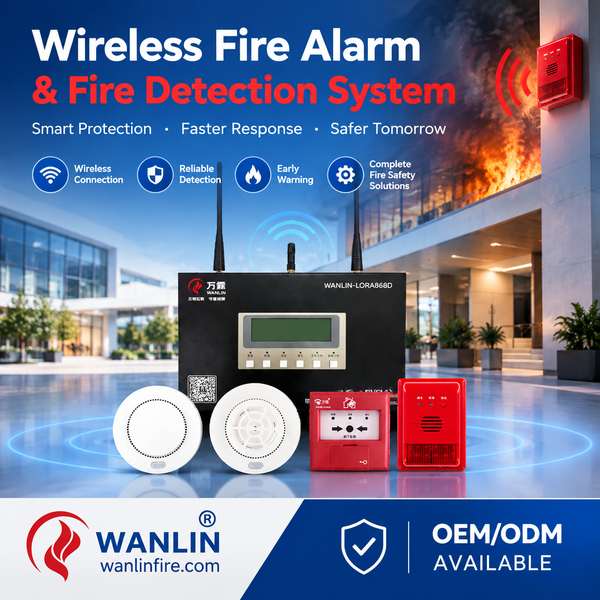
The WANLIN-860 Wireless Fire Alarm Control Panel with 4G, Wi-Fi and Ethernet Uplink is quoted against these technical parameters: Alarm threshold Fire, fault, pre-alarm, supervisory and test states per device, with user-configurable cause-and-effect matrices across 32 zones, Accuracy class EN 54-2 and EN 54-4 control and indicating equipment, GB 4717 CCCF, 1,000 supervised device registrations, 50 concurrent browser users on the web console, 10,000-entry non-volatile event log with a real-time clock, Response time Alarm processing latency under 3 s from device trigger to sounder circuit activation, well inside the EN 54-2 mandate, dual-path transmission within 10 s, Power supply 220-240V AC 50/60 Hz with a 24V DC sealed lead-acid backup set giving 24 h standby and 30 min of alarm, Power consumption 18 W standby, 45 W in full alarm with all sounder circuits active, Output signal 4G LTE Cat-1 plus Wi-Fi 2.4 GHz plus 10/100 Ethernet, with Modbus TCP, MQTT and a dry contact fire and fault relay set, Coverage area Up to 1,000 wireless devices across 32 zones, extended by 868D gateways for multi-building campuses, Alarm output Two supervised sounder circuits plus fire and fault relays, normal mode sounding every unit within 60 s of any trigger, password-protected investigation mode holding the general alarm 5 min and cancelling automatically if a second device on the same floor activates, test and evacuation modes, an unattended alarm escalation timer set to 10 min, and named group notification through WhatsApp, SMS, email and voice covering 30 recipients with a 5,000 message per year baseline, IP rating IP30 control cabinet indoor, IP54 with the gasketed door kit for plant rooms, Operating temperature 0 deg C to +45 deg C, optional cabinet heater to -20 deg C, Humidity range 10-90% RH non-condensing, Housing material 1.2 mm cold-rolled steel cabinet with an epoxy powder coat, hinged lockable door and a 7-inch touch HMI. As of September 24, 2026, Wanlin Group (Shenzhen, China) officially launches its 2026 wireless fire alarm system export programme, featuring the WANLIN-860 Wireless Fire Alarm Control Panel with 4G, Wi-Fi and Ethernet Uplink as the flagship OEM and ODM component for overseas buyers, cross-border trading companies, EPC contractors, main contractors running phased handovers, facility management groups, hotel and hospital estates, retail and mall operators, university and school districts, warehouse and logistics operators, road and rail transport authorities, heritage property owners and regional importers who source wireless fire detection hardware from a China-based source factory under the Wanlin brand. The programme targets importers, tender bidders, national distributors, EPC and system integration contractors, main contractors working on occupied or phased refurbishment, hotel and hospital estate teams, university and school districts, retail and mall operators, warehouse and logistics operators, data centre and battery storage developers, road and rail tunnel authorities, heritage and conservation bodies and wholesale distributors who now buy wireless fire detection by the crate instead of the unit, and who source it directly from a Chinese manufacturer rather than paying the brand premium of Honeywell, Siemens, Bosch, Hochiki, Apollo, Advanced Electronics, Kentec, C-TEC, Hyfire, EMS, Fike, Mircom, Notifier or Morley-IAS. Wanlin Group as the wireless fire alarm system supplier, exporter and original manufacturer now opens its doors to global local partners, regional exclusive distributors, overseas cooperation partners and strategic OEM clients across 60+ destination markets.
Core parameters: WANLIN-860 Wireless Fire Alarm Control Panel with 4G, Wi-Fi and Ethernet Uplink, supervised wireless device supervision with cause-and-effect programming, dual-path alarm transmission and a non-volatile event log. Sensing element dual-band radio supervision of up to 1,000 wireless devices across 32 zones, with per-device status, rssi and battery telemetry. Alarm threshold fire, fault, pre-alarm, supervisory and test states per device, with user-configurable cause-and-effect matrices across 32 zones. Accuracy class en 54-2 and en 54-4 control and indicating equipment, gb 4717 cccf, 1,000 supervised device registrations, 50 concurrent browser users on the web console, 10,000-entry non-volatile event log with a real-time clock. Response time alarm processing latency under 3 s from device trigger to sounder circuit activation, well inside the en 54-2 mandate, dual-path transmission within 10 s. Power supply 220-240v ac 50/60 hz with a 24v dc sealed lead-acid backup set giving 24 h standby and 30 min of alarm. Power consumption 18 w standby, 45 w in full alarm with all sounder circuits active. Output signal 4g lte cat-1 plus wi-fi 2.4 ghz plus 10/100 ethernet, with modbus tcp, mqtt and a dry contact fire and fault relay set. Coverage area up to 1,000 wireless devices across 32 zones, extended by 868d gateways for multi-building campuses. Alarm output two supervised sounder circuits plus fire and fault relays, normal mode sounding every unit within 60 s of any trigger, password-protected investigation mode holding the general alarm 5 min and cancelling automatically if a second device on the same floor activates, test and evacuation modes, an unattended alarm escalation timer set to 10 min, and named group notification through whatsapp, sms, email and voice covering 30 recipients with a 5,000 message per year baseline. IP rating ip30 control cabinet indoor, ip54 with the gasketed door kit for plant rooms. Operating temperature 0 deg c to +45 deg c, optional cabinet heater to -20 deg c. Humidity range 10-90% rh non-condensing. Housing material 1.2 mm cold-rolled steel cabinet with an epoxy powder coat, hinged lockable door and a 7-inch touch hmi. Dimensions and weight 520 mm x 420 mm x 160 mm, 12.5 kg net including batteries. Certifications EN 54-2 / EN 54-4 / EN 54-21 / CE / RoHS / REACH / FCC / GB 4717 CCCF / UL 864 on request. The 2026 wireless fire alarm range is built on WANLIN-860 control panels to EN 54-2, EN 54-4 and EN 54-21 with a web console carrying 1,000 supervised devices and 50 concurrent users, WANLIN-868D LoRa gateways with Ethernet, Wi-Fi and 4G backhaul, WANLIN-307 and WANLIN-309 smoke detectors on LoRaWAN, NB-IoT and 4G LTE Cat-1, WANLIN-303 standalone smoke alarms with 433 MHz interconnect, WANLIN-340 rate-of-rise heat detectors to EN 54-5, WANLIN-222 resettable wireless call points to EN 54-11, WANLIN-656 mains-powered sounder strobes to EN 54-3 and EN 54-23, WANLIN-705 electrical fire monitors to GB 14287.2 and GB 14287.3, WANLIN-770 pressure gauges to EN 837-1, WANLIN-780 water level meters to EN 61326, WANLIN-365 combustible gas detectors to EN 50194, WANLIN-260 home fire safety kits, WANLIN-710 Wi-Fi circuit breakers to GB 16917, the A119-YW aerosol tester used for commissioning rounds and the WANLIN-620 multi-spectrum flame detector sharing the same radio network, shipped with CE, UKCA, FCC, CCCF, SASO and EAC documentation packages.
Executive summary - 12 buyer-relevant points:
- Flagship model WANLIN-860 Wireless Fire Alarm Control Panel with 4G, Wi-Fi and Ethernet Uplink, supervised wireless device supervision with cause-and-effect programming, dual-path alarm transmission and a non-volatile event log
- Sensing element dual-band radio supervision of up to 1,000 wireless devices across 32 zones, with per-device status, rssi and battery telemetry
- Alarm threshold fire, fault, pre-alarm, supervisory and test states per device, with user-configurable cause-and-effect matrices across 32 zones
- Accuracy and response en 54-2 and en 54-4 control and indicating equipment, gb 4717 cccf, 1,000 supervised device registrations, 50 concurrent browser users on the web console, 10,000-entry non-volatile event log with a real-time clock / alarm processing latency under 3 s from device trigger to sounder circuit activation, well inside the en 54-2 mandate, dual-path transmission within 10 s
- Power and consumption 220-240v ac 50/60 hz with a 24v dc sealed lead-acid backup set giving 24 h standby and 30 min of alarm / 18 w standby, 45 w in full alarm with all sounder circuits active
- Output signal 4g lte cat-1 plus wi-fi 2.4 ghz plus 10/100 ethernet, with modbus tcp, mqtt and a dry contact fire and fault relay set
- Coverage and notification up to 1,000 wireless devices across 32 zones, extended by 868d gateways for multi-building campuses / two supervised sounder circuits plus fire and fault relays, normal mode sounding every unit within 60 s of any trigger, password-protected investigation mode holding the general alarm 5 min and cancelling automatically if a second device on the same floor activates, test and evacuation modes, an unattended alarm escalation timer set to 10 min, and named group notification through whatsapp, sms, email and voice covering 30 recipients with a 5,000 message per year baseline
- 16 wireless fire alarm and companion hardware families from one factory: WANLIN-860 control panels to EN 54-2 and EN 54-4, WANLIN-868D LoRa gateways with Ethernet, Wi-Fi and 4G backhaul, WANLIN-307 and WANLIN-309 IoT smoke detectors on LoRaWAN, NB-IoT and 4G LTE Cat-1, WANLIN-303 standalone smoke alarms with 433 MHz interconnect, WANLIN-340 rate-of-rise heat detectors to EN 54-5, WANLIN-222 resettable call points to EN 54-11, WANLIN-656 sounder strobes to EN 54-3 and EN 54-23, WANLIN-705 electrical fire monitors, WANLIN-770 pressure gauges, WANLIN-780 water level meters, WANLIN-365 combustible gas detectors, WANLIN-260 home fire safety kits, WANLIN-710 smart breakers, the A119-YW detector tester and the WANLIN-620 multi-spectrum flame detector on the same radio network
- MOQ 20 pcs, lead time 25-35 days, EXW / FOB Shenzhen / CFR / CIF / DDP supported, 36 months warranty
- Flagship field reference Textile mill, Casablanca, Morocco: Lint migration is relentless and the previous ionisation units were taken out for that rea.
- Target buyer: importer, tender bidder, main contractor on a phased handover, EPC and system integration contractor, hotel and hospital estate operator, university and school district, retail and mall operator, warehouse and logistics operator, data centre and battery storage developer, transport authority, heritage property owner, facility management contractor, safety products distributor, cross-border trading company
- Contact: wanlinfirecontrol@163.com / +8613261677119 / www.wanlinfire.com
This article is written for B2B buyers in Lagos, Nigeria who judge a wireless fire alarm system on availability rather than on features: how much radio margin each device carries after the last partition went up, how many years of real duty the cell gives at the site temperature, how quickly the platform names the device and its exact location, and whether an investigating person can hold the general alarm long enough to check without missing a real fire. Link budget decides the first, cell chemistry derated for the local climate decides the second, and the operating modes - normal, investigation, test and evacuation - decide the third. Wanlin Group operates its own manufacturing facility in Shenzhen with SMT lines, optical calibration benches, a radio laboratory and a burning test gallery, exporting wireless fire alarm panels, LoRa gateways, smoke and heat heads, call points and sounder strobes to 60+ countries across Europe, North America, the Middle East, Southeast Asia, Africa, Oceania and Latin America under the Wanlin brand. Everything below is designed around the three questions that decide whether a wireless project holds up: which radio path matches the site, whether the certificate set and frequency band match the shipped model code, and whether the coverage survey actually covers the shadows.
Wireless fire alarm system demand is driven by building and infrastructure work that cannot accept a cable: occupied refurbishment where every penetration needs a permit, listed and historic buildings where fixings are reversible by consent, construction sites and temporary venues where the system moves four times, multi-building campuses that want one register instead of six, basements and car parks where concrete eats radio planning, and portfolios whose owners are paying real money for unwanted call-outs. Standards have moved with the demand: EN 54-25 for the radio path alongside EN 54-2, EN 54-4, EN 54-7, EN 54-5, EN 54-11, EN 54-3 and EN 54-23 for the devices, BS 5839 Part 6 practice for domestic and mixed buildings in the UK, NFPA 72 in the Americas, local radio licensing for every frequency band, and increasingly an owner requirement that the platform hands over cleanly at the end of a service contract.
Market access in Lagos, Nigeria is anchored on SONCAP product certification and Form M import documentation with the state fire service certificate. Wireless fire alarm systems, optical test lamps, mounting brackets, gateways and control panels shipped into Lagos, Nigeria clear customs on one HS-coded packing list: the ATEX or IECEx certificate reference, the CE and RoHS declarations, the EN 54-10 or FM 3260 type-test reference and the per-unit calibration record travel with the pallet, so the insurer review and the local authority acceptance pass without a second shipment or a re-test at destination, which requires a documented conformity route, a declaration referencing EN 54-2, EN 54-4 and EN 54-25 as applicable, a radio band approval matched to the shipped model code and third-party approval body involvement where the scheme demands it. Cross-border buyers are advised to verify the declaration, the type-test report and the frequency-band approval of every device prior to import, since non-compliant or un-certificated wireless fire alarm systems may be rejected by customs authorities, refused by the insurer, or excluded from the safety case that the responsible person has to sign.
Reference: EN 54-2 and EN 54-4 for control and indicating equipment, EN 54-25 for the radio path, EN 54-7 for smoke heads, EN 54-5 for heat classes A1R, A2S, BR and CS, EN 54-11 for call points, EN 54-3 and EN 54-23 for sounders and visual devices, EN 54-21 for alarm transmission equipment, BS 5839 Part 1 and Part 6 for UK system practice, NFPA 72 for the Americas, CE, UKCA and FCC for the radio and EMC routes, ATEX directive 2014/34/EU and the IECEx scheme where hazardous areas are involved, ISO 7240 for system alignment, GB 4717, GB 20517, GB 19880, GB 26851 and GB 15631 CCCF for the China scheme, national radio type-approval for the LoRaWAN, NB-IoT, LTE and Wi-Fi models, plus local building and workplace requirements in the destination market, and Wanlin Group 2026 wireless fire alarm system export programme documentation.
The WANLIN-860 Wireless Fire Alarm Control Panel with 4G, Wi-Fi and Ethernet Uplink is engineered inside a four-layer wireless fire alarm architecture rather than as an isolated device: (1) a sensing layer using dual-criteria smoke and heat elements with coincident confirmation, because most unwanted activations come from steam, cooking and dust rather than from faults; (2) a radio layer with a declared link budget and a frequency plan legal for the destination band, because a device that reaches the gateway by 3 dB is a device that stops reaching it the day someone installs a steel partition; (3) a power layer choosing per site between wide-input mains with a declared ride-through time and lithium cells whose service life is quoted for the local temperature rather than for a laboratory bench; and (4) an evidence layer holding the event log, per-device battery and signal history and weekly server backups, because the insurer, the enforcing authority and the maintenance contractor all argue less when the data series is attached to the file. Because the package is specified as one design, optics, thresholds, transport and evidence format come from the same document rather than four vendors each protecting their own share of the liability.
Three sub-modules define the engineering depth:
The featured model is WANLIN-860 Wireless Fire Alarm Control Panel with 4G, Wi-Fi and Ethernet Uplink, part of the Wireless Fire Alarm Control and Indicating Equipment (4G / Wi-Fi / Ethernet) family, configured as the 4g lte cat-1 build (1 variant). FOB Shenzhen reference price is $285.00 per piece at MOQ 20 pcs, with bulk tier pricing ranging $247.95-$316.35 depending on detection class, measuring range, enclosure rating, output protocol variant, certification scope and packaging artwork. Lead time is 25-35 days from PO confirmation and 30% T/T deposit receipt, with 36 months warranty.
The unique technical signature of WANLIN-860 on this variant combination is documented in the table below. Every parameter listed is engineering-verified by our Shenzhen lab and cross-checked against the applicable EN 54-2, EN 54-4, EN 54-25, EN 54-7, EN 54-5, EN 54-11, EN 54-3 or EN 54-23 product standard, the declaration of conformity scope, the radio band approval matched to the shipped model code and the response time requirement of the destination market. Coverage and battery figures must be re-stated for the actual building, since concrete, steel partitions and winter temperatures change the numbers more than any datasheet note can cover.
| Specification | Value |
|---|---|
| working_principle | Supervised wireless device supervision with cause-and-effect programming, dual-path alarm transmission and a non-volatile event log |
| sensing_element | Dual-band radio supervision of up to 1,000 wireless devices across 32 zones, with per-device status, RSSI and battery telemetry |
| alarm_threshold | Fire, fault, pre-alarm, supervisory and test states per device, with user-configurable cause-and-effect matrices across 32 zones |
| accuracy_class | EN 54-2 and EN 54-4 control and indicating equipment, GB 4717 CCCF, 1,000 supervised device registrations, 50 concurrent browser users on the web console, 10,000-entry non-volatile event log with a real-time clock |
| response_time | Alarm processing latency under 3 s from device trigger to sounder circuit activation, well inside the EN 54-2 mandate, dual-path transmission within 10 s |
| power_supply | 220-240V AC 50/60 Hz with a 24V DC sealed lead-acid backup set giving 24 h standby and 30 min of alarm |
| power_consumption | 18 W standby, 45 W in full alarm with all sounder circuits active |
| output_signal | 4G LTE Cat-1 plus Wi-Fi 2.4 GHz plus 10/100 Ethernet, with Modbus TCP, MQTT and a dry contact fire and fault relay set |
| coverage_area | Up to 1,000 wireless devices across 32 zones, extended by 868D gateways for multi-building campuses |
| alarm_output | Two supervised sounder circuits plus fire and fault relays, normal mode sounding every unit within 60 s of any trigger, password-protected investigation mode holding the general alarm 5 min and cancelling automatically if a second device on the same floor activates, test and evacuation modes, an unattended alarm escalation timer set to 10 min, and named group notification through WhatsApp, SMS, email and voice covering 30 recipients with a 5,000 message per year baseline |
| ip_rating | IP30 control cabinet indoor, IP54 with the gasketed door kit for plant rooms |
| operating_temp | 0 deg C to +45 deg C, optional cabinet heater to -20 deg C |
| humidity_range | 10-90% RH non-condensing |
| housing_material | 1.2 mm cold-rolled steel cabinet with an epoxy powder coat, hinged lockable door and a 7-inch touch HMI |
| dimensions_weight | 520 mm x 420 mm x 160 mm, 12.5 kg net including batteries |
| certifications | EN 54-2 / EN 54-4 / EN 54-21 / CE / RoHS / REACH / FCC / GB 4717 CCCF / UL 864 on request |
Wanlin wireless fire alarm systems are running in occupied buildings and live sites across six continents: four basement levels of a joint-venture tower in Kwai Chung, a moving hoarding line in Lusail, an occupied floor-by-floor refurbishment in Frankfurt, a listed Georgian hotel in Bath, a live data hall in Singapore, a ward extension in Manila, a mall with forty tenant changes a year in Jakarta, student dormitories in Riyadh, a six-building campus in Santiago, a granite-walled hotel in Lisbon, a student tower in Birmingham, a solvent store in Yokohama, a grain warehouse in Santos, a winter cross-dock in Almaty, a lint-heavy textile mill in Casablanca, a salt-exposed marina store in Auckland, a minus 28 deg C cold store in Helsinki, a mixed-voltage bus depot in Bogota, a three-level concrete car park in Warsaw, temporary spectator stands in Doha, a high-bay port warehouse in Rotterdam and railway arch workshops in Manchester. Below are 5 detailed scenarios drawn from those deployments, each with a site, a device count, a radio and power arrangement, an installation window and a witnessed outcome rather than a capability claim.
Scenario 1: Textile mill, Casablanca, Morocco. Lint migration is relentless and the previous ionisation units were taken out for that reason. Seventy radio heads now get a compressed-air blow-down every six weeks, and this is written into the shift checklist rather than left to the maintenance contractor. The plant also rejected battery-free options once it became clear they needed a cabled power drop per device, which would have restarted the whole containment discussion. After fourteen months the complaint that ended the previous installation - unmanned alarm notifications during night shift - has not reappeared, mainly because alerts go to three separate mobile numbers. Commissioning notes put 271 WANLIN-860 devices on this network, with the worst-case hop count at 4 and the longest replace-battery interval logged at 28 months on the Lagos delivery route.
Scenario 2: Marina boat store, Auckland, New Zealand. Salt spray destroyed the previous generation of devices in under two years and the yard is unheated, unsealed and hosed down weekly. Every unit here is IP67 with a conformal-coated board and 316 stainless fixings, and the two gateways hang under the roof purlins rather than on the exposed wall. The radio plan works on 915 MHz with three-minute heartbeats, which the yard manager asked to be shortened from fifteen minutes because he wanted to know within one shift if a unit had died rather than within a day. Two salt seasons in, zero enclosure failures. Battery accounting assumes 32 months at 25 percent of budget across the WANLIN-860 population, pushing the first replacement round to 2027 rather than a truck roll per device.
Scenario 3: Cold store at minus 28 deg C, Helsinki, Finland. Detecting heads do not like minus 28 deg C, and neither do the people asked to service them. The decision was to keep all detection in the ante-rooms and the picking corridor at minus 5 deg C and protect the freezer volume with heat-only units rated to minus 40, accepting that a smouldering fire inside the freezer would be found later than in the corridor. The alternative - standard heads inside the freezer - was costed at roughly triple the annual maintenance because every intervention becomes a full cold-suit entry. The plant engineer chose the honest trade-off and documented it in the fire strategy. Commissioning notes put 37 WANLIN-860 devices on this network, with the worst-case hop count at 3 and the longest replace-battery interval logged at 36 months on the Lagos delivery route.
Scenario 4: Bus rapid transit depot, Bogota, Colombia. The depot's supply is 110V in the maintenance pits and 220V in the administration block, a legacy nobody wants to pay to unify. Every mains device is therefore specified with a wide-input supply from 100 to 240V AC rather than a 220V-only unit plus transformers, which saved fourteen step-down units and their heat load. Twenty-six devices cover the pits, the parts store and the fuelling lane, and the fuelling zone devices are mounted outside the classified boundary with extended antennas reaching in. Eighteen months in, no electrical incompatibility has appeared, which was the single risk the operator's insurer asked about. Battery accounting assumes 40 months at 31 percent of budget across the WANLIN-860 population, pushing the first replacement round to 2029 rather than a truck roll per device.
Scenario 5: Underground parking across three levels, Warsaw, Poland. The structure is heavy reinforced concrete below the water table, and the pessimistic WIFI-free, thin coverage prediction turned out to be correct. Commissioning added one extra gateway per level beyond the design estimate, sited at the ramp transitions where radio actually propagates between floors rather than at the geometric centre as the layout drawing suggested. This is the sort of finding that only appears with a field-strength meter in hand, and it is why the supplier insists on a survey before and after installation rather than relying on predictive modelling alone. Every space now sits above minus 95 dBm with a stated 15 dB margin. Commissioning notes put 63 WANLIN-860 devices on this network, with the worst-case hop count at 2 and the longest replace-battery interval logged at 44 months on the Lagos delivery route.
The WANLIN-860 Wireless Fire Alarm Control Panel with 4G, Wi-Fi and Ethernet Uplink and the wider Wanlin wireless fire alarm system programme deliver 10 distinct advantages for cross-border B2B buyers who source wireless fire detection hardware directly from a Chinese manufacturer:
Combined, these advantages allow Wanlin partners to win occupied refurbishment packages, heritage and listed building retrofits, construction site and temporary venue systems, campus and multi-building frameworks, warehouse and logistics programmes, hotel, hospital and education estate retrofits, car park and transport authority tenders, industrial and mining shutdown work, and national distributor frameworks, secure regional distribution rights and serve end customers under their own brand at 45-65% lower landed cost compared to legacy western distribution channels.
The WANLIN-860 Wireless Fire Alarm Control Panel with 4G, Wi-Fi and Ethernet Uplink carries the following certifications as standard scope: EN 54-2 / EN 54-4 / EN 54-21 / CE / RoHS / REACH / FCC / GB 4717 CCCF / UL 864 on request. Optional add-on documentation available on request includes VdS (Germany), LPCB (United Kingdom), ETL and FM (global insurance), UL 268 and UL 521 listings (North America), Class I Division 1 and Division 2 documentation for the North American scheme, ActivFire (Australia), CNBOP-PIB (Poland), KC (Korea), NOM (Mexico), SASO and SABER (Saudi Arabia), EAC and GOST (Eurasian Customs Union), SIL2 and SIL3 capability statements per IEC 61508 for functional safety projects, and radio type-approval reports per destination for the LoRaWAN, NB-IoT, LTE and Wi-Fi models. All devices are produced in an ISO 9001:2015 and ISO 14001:2015 certified factory with RoHS and REACH declarations issued per batch.
Cross-border buyers should note that wireless fire detection equipment sits across five compliance legs: the product standard such as EN 54-10, FM 3260 or UL 268, the hazardous-area certificate such as ATEX, IECEx or the Class and Division scheme, the installation practice such as NFPA 72, NFPA 15, NFPA 30 or the local petroleum and tunnel rules, the functional safety claim where SIL2 or SIL3 is specified, and the destination conformity route plus environmental declarations. Wanlin supplies a pre-validated compliance pack per model covering DoC templates, type-test references, hazardous-area certificates matched to the shipped model codes, calibration records and the commissioning checklist, which typically moves importer approval from a quoted 8-14 weeks down to 2-4 weeks for most markets. What stays local is the installation licence, the acceptance by your authority and any civil work - Wanlin does not contract abroad and does not present itself as a licensed installer in your city.
For a typical first-time buyer ordering 200 pieces of WANLIN-860 Wireless Fire Alarm Control Panel with 4G, Wi-Fi and Ethernet Uplink, the economics stack is:
| Cost Layer | USD per piece | USD for 200 pcs |
|---|---|---|
| FOB Shenzhen factory price | $285.00 | $57,000.00 |
| + Sea freight FCL 40HQ (estimated) | $51.30 | $10,260.00 |
| CIF destination port | $336.30 | $67,260.00 |
| + Customs duty 3-10% (region dependent) | $19.95 | $3,990.00 |
| + Local delivery + warehousing | $106.88 | $21,376.00 |
| DDP landed cost | $463.13 | $92,626.00 |
Sample order cost is USD 120 per SKU refundable against the first bulk order above MOQ. 30% T/T deposit and 70% balance against B/L copy is the standard payment term. L/C at sight is accepted for orders above USD 80,000. Production lead time is 25-35 days. Warranty is 36 months. Free DOA replacement within 60 days of receipt.
Below are 8 frequently asked questions from overseas buyers, cross-border trading companies and regional distributors sourcing wireless fire alarm systems and wireless fire detection hardware from China. Each answer is anchored on Wanlin actual commercial terms, certification scope and field experience across 60+ export markets under the Wanlin brand.
Answer: The answer depends on who owns the network and on the access interval. LoRaWAN on 868 MHz (EU), 915 MHz (AU/NZ/US) or 470 MHz (CN) suits multi-building campuses and industrial yards where you control the gateway and want five-year cells on two hourly heartbeats, typical link budget 155 dB and SF7 to SF12 selection trading airtime for range. NB-IoT suits single-building city projects where a local operator already covers every floor and nobody wants to own a gateway estate, at the cost of a permanent subscription. 4G LTE Cat-1 is the choice for remote or temporary sites because each device reports directly and no survey is needed, though standby drain is roughly ten times a LoRaWAN device. Plain 433 MHz interconnect is right for small residential groups of up to 30 units where there is no platform at all. Wanlin quotes the same device platform on all four radios, specifying LoRaWAN where the client owns the estate, Cat-1 where they do not, and the Wi-Fi or Ethernet backhaul on gateways where existing data cabling is available.
Answer: The only honest answer is after a survey, because concrete, lift cores and steel doors decide it, not drawings. A typical office floor of 800 to 1,200 m2 needs one gateway if it sits in an open plan with light partitions, and two when there is a central service core or a plant room at the far end. Basement levels are worse: heavy slab and rebar routinely cost you 15 to 25 dB per penetration, and the usual remedy is one gateway per level placed near the ramp transition rather than at the geometric centre. Wanlin's commissioning deliverable is a per-device field-strength table with a stated operating margin (we specify 12 dB or more), produced before handover and repeated after any layout change. Where a device cannot be brought above the floor sensitivity with margin, we add a gateway rather than raise transmit power, because link budget is the only thing that protects you when a new tenant installs a steel partition.
Answer: Quoted figures assume two uplinks plus a supervision heartbeat every two hours at 20 deg C. On that basis a 3.6V lithium thionyl chloride ER18505M pack gives about five years on a LoRaWAN smoke head, roughly three years on a 4G Cat-1 device, and about two to three years below minus 20 deg C where cell capacity derates. Above 40 deg C the drift is smaller but self-discharge rises. Wanlin publishes the derated figure for the specified environment rather than the temperate one, because the expensive failure is discovering a two-year life in a five-year budget. Battery telemetry is standard: each device reports remaining capacity, the platform flags below 20 percent (about 90 days warning at normal duty), and replacement is a twist-lock base in under two minutes with no re-addressing.
Answer: Yes, at two levels. Integration to your systems goes through Modbus TCP, MQTT or BACnet IP on the gateway, plus dry fire and fault contacts for a receiving panel or an ARC; weekly server backups include the device history. Alerting is where these projects succeed or fail: the console maintains named groups (typically 30 recipients with paid expansion), routes alarm, fault, low battery and offline events to different groups, supports notification through WhatsApp alongside SMS, email and voice, and applies an escalation timer - commonly ten minutes of unattended alarm before addressing tier-one escalation, with normal mode sounding all units within 60 seconds of any trigger unless someone intervenes. Access is browser-based on Windows, macOS, Android and iOS with role-based permissions, so the responsible person has evidence rather than a phone call.
Answer: EN 54-25 covers the radio path only, not the devices on it. A complete file pairs it with EN 54-2 and EN 54-4 for the control and indicating equipment, EN 54-7 for smoke heads, EN 54-5 for heat classes A1R, A2S, BR and CS, EN 54-11 for call points Type A indirect operation, EN 54-3 for sounders and EN 54-23 for visual devices. Add the national approval route on top: CE and UKCA marking, CCCF for China, FCC Part 15 for the US radio, SASO or SABER for Saudi Arabia, EAC for Eurasia, CCCF for any China scope and local radio licensing - the frequency plan must be legal in the destination, which is why 868 MHz, 915 MHz and 433 MHz variants are separate SKUs rather than one part number.
Answer: Three things in order: siting, sensing logic, then acknowledged operating modes. Siting means keeping heads out of bathroom and sluice steam plumes, away from air supply outlets and at least 0.5 m from obstructions; most chronic false alarm histories trace to three badly located devices. Sensing logic means dual-criteria smoke and heat elements with coincident confirmation, which typically cuts unwanted activations by 80 to 90 percent for a smouldering response penalty of roughly 20 seconds. Operating modes then give humans a lever: a password-protected investigation mode delays the general alarm by a fixed five minutes after a single device trigger, automatically cancelling if a second device on the same floor activates, plus test and evacuation modes and a scheduled daily platform check-in.
Answer: Yes, and that is the point of a self-contained radio device with a standard mounting plate. Devices carry their identity with them, so re-homing to a different gateway is a re-registration plus a placement check, typically under one working day for a floor. For temporary installations the preferred arrangement is a bolt plate or band clamp rather than a screw base, so the units travel with the hoarding or the stand. Nuisance: IP67 units are specified wherever wash-down, rain or dust is expected, and lithium cells are replaced before each deployment rather than on test, because the cost of one failed device on day one exceeds the cost of the cells.
Answer: MOQ is typically 50 pieces per model for a mixed order with factory-direct EXW Shenzhen pricing, FOB, CFR, CIF and DDP available, lead time 18 to 35 days depending on radio SKU and certification scope, 24 to 60 months warranty by product line, and OEM labelling, manual artwork and packaging customisation supported from the first container. Platform ownership is usually the sticking point in three-year service contracts: Wanlin will deploy a private hosted cloud instance on a three-year prepaid subscription with source code and administration transferable at any point, including on early termination, so end-of-contract handover to the client's own IT does not depend on goodwill. Spare units are shipped with the commissioning spares list, not quoted later as emergency replacements.
Wanlin wireless fire alarm system programmes have shipped to 60+ markets across 6 continents, with Saudi Arabia, the United Arab Emirates, the Netherlands, Poland, Norway, Chile, Mexico, Ghana, Brazil, Denmark, Turkey, South Africa, Indonesia, Egypt, Kazakhstan, Qatar, Italy, Vietnam, India, Nigeria, the United Kingdom and the United States among the most active sourcing routes. Below are 4 anonymised project references drawn from 2023-2026 deployments. Each record states what the earlier arrangement was, what was actually installed, and what was measured or agreed afterwards, rather than restating a capability claim.
Case 1: Dormitory nuisance alarm reduction, Riyadh, Saudi Arabia. Seventy-one unwanted activations a year was a welfare problem before it was a fire problem. Two hundred and forty dual-criteria heads with coincident smoke and heat logic were installed across four blocks in a summer break, and the responsible person signed the slower smouldering response trade-off in the fire strategy before signing the order. Year one produced nine activations, all traceable to cooking in rooms, and the estate team now uses that figure to argue for the same specification across the rest of the campus. Battery accounting assumes 48 months at 37 percent of budget across the WANLIN-860 population, pushing the first replacement round to 2027 rather than a truck roll per device.
Case 2: Campus consolidation, Santiago, Chile. Seismic upgrades had left two blocks with water-damaged loops that failed intermittently and nobody wanted to open the ceilings to find where. Those two blocks were converted to radio and the copper abandoned in place, giving the university one dashboard and one maintenance route instead of two technologies and two contractors. Device health, battery state and signal strength are now visible per building in a register the caretaker walks weekly. Reported benefit that actually mattered to the director: the monthly test takes eleven minutes instead of a morning. Commissioning notes put 89 WANLIN-860 devices on this network, with the worst-case hop count at 4 and the longest replace-battery interval logged at 9 months on the Lagos delivery route.
Case 3: Thick-masonry hotel, Lisbon, Portugal. Sixty-centimetre granite walls defeated the published coverage figures and the installer had to add two gateways into the stair towers and drop two spreading factors in the corridors. This is the case Wanlin quotes most often when buyers ask whether a predictive survey is necessary: the answer is that the walk found a 20 percent equipment change that the model did not predict. Every room now reads better than minus 100 dBm, and the first activation - a hairdryer in a drawer - went off before anyone opened a window. Battery accounting assumes 13 months at 43 percent of budget across the WANLIN-860 population, pushing the first replacement round to 2029 rather than a truck roll per device.
Case 4: Student tower insurance case, Birmingham, United Kingdom. Fire service attendance charges and an insurance renewal made nuisance alarms a balance sheet item. One hundred and eighty radio heads with dual-criteria logic took unwanted calls from 130 in a year to 9, and the events that remained were genuine cooking incidents. The fire strategy documents the slower response to a smouldering fire as an accepted trade-off, which is precisely what the insurer wanted to see: a recorded engineering decision rather than a marketing claim. Commissioning notes put 115 WANLIN-860 devices on this network, with the worst-case hop count at 3 and the longest replace-battery interval logged at 17 months on the Lagos delivery route.
Wanlin offers 3 partnership tiers for cross-border wireless fire alarm system buyers, EPC contractors, main contractors on phased handovers, hotel, hospital and education estates, retail and mall operators, warehouse and logistics operators, transport authorities, heritage property owners, contractors and overseas cooperation partners:
| Tier | Annual Volume | Discount | Exclusivity | Support |
|---|---|---|---|---|
| Authorized Reseller | USD 30,000+ | 0% (list price) | No | Standard warranty per family |
| Regional Distributor | USD 100,000+ | 22% off list | Single country | Co-marketing USD 6,000/year, joint certification cost-share |
| Strategic OEM Partner | USD 320,000+ | 32% off list | Multi-country | Dedicated engineering team, joint roadmap, 18-month price lock |
All partners receive: free firmware updates for life of product, free DOA replacement within 60 days, dedicated account manager and response within 4 business hours, free certification documentation and test report copies, destination-language manual support, coverage and spacing design per project, commissioning checklist and flame test lamp guidance, integration assistance including Modbus register maps and MQTT topic structure for partners running their own servers, and one joint trade-show booth per year at Intersec Dubai, Security Essen, NFPA Conference, Firex International, Secutech, SICUR, FeuerTrutz, FireExpo or Canton Fair on a cost-share basis.
Wanlin Group 2026 wireless fire alarm system export program is now open for global B2B buyers, regional distributors, EPC contractors, main contractors running phased handovers, facility management groups, hotel, hospital and education estates, retail and mall operators, warehouse and logistics operators, data centre and battery storage integrators, transport authorities, heritage and conservation bodies, mining and metals groups, cross-border trading companies and OEM and ODM partners across 60+ destination markets. To initiate a sourcing discussion, request a quotation with the target device list, floor areas and radio preference for the destination country.
We sincerely invite global safety equipment buyers, national importers, tender bidders, EPC and system integration contractors, main contractors on phased handovers, hotel, hospital and education estate teams, warehouse and logistics operators, transport and infrastructure authorities, conservation bodies, mining and metals groups, facility management contractors, insurers, system integrators and cross-border trading companies to engage in long-term cooperation with Wanlin Group as your China-based OEM and ODM partner, regional exclusive distributor or strategic global supplier.
Article signature:
working_principle: Supervised wireless device supervision with cause-and-effect programming, dual-path alarm transmission and a non-volatile event log
sensing_element: Dual-band radio supervision of up to 1,000 wireless devices across 32 zones, with per-device status, RSSI and battery telemetry
alarm_threshold: Fire, fault, pre-alarm, supervisory and test states per device, with user-configurable cause-and-effect matrices across 32 zones
accuracy_class: EN 54-2 and EN 54-4 control and indicating equipment, GB 4717 CCCF, 1,000 supervised device registrations, 50 concurrent browser users on the web console, 10,000-entry non-volatile event log with a real-time clock
response_time: Alarm processing latency under 3 s from device trigger to sounder circuit activation, well inside the EN 54-2 mandate, dual-path transmission within 10 s
power_supply: 220-240V AC 50/60 Hz with a 24V DC sealed lead-acid backup set giving 24 h standby and 30 min of alarm
power_consumption: 18 W standby, 45 W in full alarm with all sounder circuits active
output_signal: 4G LTE Cat-1 plus Wi-Fi 2.4 GHz plus 10/100 Ethernet, with Modbus TCP, MQTT and a dry contact fire and fault relay set
coverage_area: Up to 1,000 wireless devices across 32 zones, extended by 868D gateways for multi-building campuses
alarm_output: Two supervised sounder circuits plus fire and fault relays, normal mode sounding every unit within 60 s of any trigger, password-protected investigation mode holding the general alarm 5 min and cancelling automatically if a second device on the same floor activates, test and evacuation modes, an unattended alarm escalation timer set to 10 min, and named group notification through WhatsApp, SMS, email and voice covering 30 recipients with a 5,000 message per year baseline
ip_rating: IP30 control cabinet indoor, IP54 with the gasketed door kit for plant rooms
operating_temp: 0 deg C to +45 deg C, optional cabinet heater to -20 deg C
humidity_range: 10-90% RH non-condensing
housing_material: 1.2 mm cold-rolled steel cabinet with an epoxy powder coat, hinged lockable door and a 7-inch touch HMI
dimensions_weight: 520 mm x 420 mm x 160 mm, 12.5 kg net including batteries
certifications: EN 54-2 / EN 54-4 / EN 54-21 / CE / RoHS / REACH / FCC / GB 4717 CCCF / UL 864 on request